"In May 2014, the National Weather Service opened a new National Water Center in Tuscaloosa, Alabama, that led me to a new adventure in creating a National Water Model. This model brought water into GIS as an animated map of water flow throughout the stream network of the continental United States. I remember seeing this map for the first time with Jack in 2016. I have never seen Jack so happy as he was on that day.
As you will have gathered, the Esri community, and Jack more personally, has inspired my life’s work. It has been a privilege to write Geowater as a culmination of that work. "
About the Author
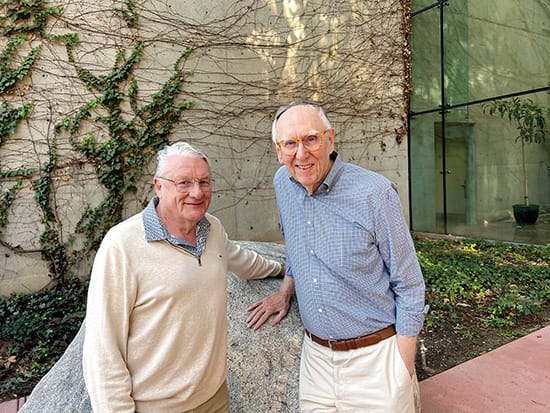
In the preface to his book The Power of Where, Jack Dangermond describes an “aha!” moment he had while flying home over the western United States as a graduate student at the University of Minnesota. Looking out from his window seat, he saw the various worlds beneath the plane as a system of interconnected systems, motivating his life’s work to create Esri in the town where he grew up—Redlands, California. I grew up in a different world, in rural New Zealand, and did not live in a city until I began my university studies. I was drawn to the study of the natural environment, first in agricultural engineering at the University of Canterbury in New Zealand and later in civil engineering as a hydrologist at the University of Illinois. I’ve always loved the flow of water, and even now, I like to just sit by a river and watch the water rippling over the stones, seeing flashes of the sunlight on the water.
I began my academic career as a faculty member at the University of Texas at Austin in 1981, just after the city experienced a devastating flood. Besides my academic duties, I was asked to be the drainage engineer for a small community, Rollingwood, a suburb of Austin, which had been badly damaged by the flood. I had one ordinance, or local decree, to act upon: “The full effects of development on runoff shall be accounted for.” In other words, I had to show how any new development would impact storm runoff.
Looking back, I regard this experience serving a small community nearly as important as earning my PhD because I learned about the practical world of flooding and its impact on people’s lives.
I first met Jack in 1988 when he served as a keynote speaker at a computer conference in Atlanta, Georgia. I knew nothing about GIS, but I could see that it was a larger system with a broader scope and perhaps would help me.
I remember thinking, “How am I going to learn this technology so I can teach it?” I got one of Esri’s early books, Understanding GIS: the Arc/Info Method, started my class GIS in Water Resources with chapter 1, and found a new discovery in each chapter. At the end of the semester, we succeeded in making a map! That was in 1991, and I continued to teach that class every year until I retired from teaching in 2018, tracking along with the development in methods and data over those years.
Attending my first Esri International User Conference in Palm Springs, California, in 1990, I felt immediately drawn to the sense of connectedness and community within this group. It reflected the best aspirations of society, and it was exciting and technically challenging.
In 1998, Jack came into my office at the University of Texas and said he was in the process of creating a new software system, what we now know as ArcGIS, and asked me to design a data model for water resources in that system. I published the design in my first Esri Press book in 2002.
From the Book - A Personal Journey
In September 2014, a Travis County Sheriff’s Deputy named Jessica Hollis was driving down a country lane in pitch darkness at 2 a.m. during a heavy rainstorm. As she reached a low-water crossing at the bottom of a valley, a flooded stream washed her patrol car away, and she lost her life. This tragedy happened just a few miles from my home. Her death affected the local community deeply, and me profoundly because she was 35 years old and had a son. I have two daughters, then aged 34 and 36, each with a son. I felt Jessica’s death personally, and I’ve never gotten over it. More than that, I was convinced that her life could have been saved with real-time flood information sent to her patrol car. I have worked ever since to help provide such information and prevent tragedies like this in the future.
I was at that time working on the prototype of what came to be called the National Water Model at the University of Texas at Austin. I proposed that the National Weather Service could collaborate with the academic community in the United States to create a new national flood system for data, modeling, and forecasting. In less than a year, we showed that we could compute the water flow in the 2.7 million stream reaches in the continental United States in 10 minutes—or about 5,000 stream reaches per second—a task considered inconceivable at the time. This was big data before the term came into fashion.
Today, the National Water Model has advanced by several versions and currently forecasts stream reaches beyond the continental United States to cover Alaska, Hawaii, and US overseas territories. Hurricane storm surge modeling from the National Ocean Service combines with river forecasting to predict flooding in coastal rivers during hurricane events. Four versions of the National Water Model are run simultaneously for current conditions and for short-range, medium-range, and long-range forecasting.
National Water Model
The National Water Model (NWM) is a hydrologic modeling framework that simulates observed and forecast streamflow over the entire continental United States, southern Alaska, Hawaii, Puerto Rico, and the US Virgin Islands.
2026 National Hydrologic Assessment
The 2026 National Hydrologic Assessment offers an analysis of flood risk for spring 2026, summarized at the national scale.
GEOGLOWS Initiative
A global water forecasting initiative dedicated to global water sustainability that spearheads advancements in hydrological science, with a team committed to the development and implementation of an open forecasting system for water.